 2026 TTEG Gathering: case studies, resources, and connections
IT and EdTech professionals shared technological advancements in education management systems, security, and
more
The ATS Technology in Theological Education Group (TTEG) gathered in Pittsburgh, PA, October 20-22 to share their work and perspectives on this year’s theme, “Transforming
Technology: New Systems, AI, and Helpful Tools for Our Work.” The two-day event included intensive sessions led by educators with wide technological experience from ATS member schools.
Declaring the event a success, ATS Associate Director of Leadership Development Chelsea Yarborough said, “As technology continues to expand, having conversation partners who understand
the particularity of schools and theological education is such a gift.”
Yarborough explained that TTEG is a group that is generous to one another and deeply embodies the actions of communities of practice. Each conference, she says, is centered around the real
problems, challenges and strategies that participants bring with them.
Some of the challenges addressed at the event included:
- Does the use of artificial intelligence in online learning deepen or diminish relational encounters?
- What can theological schools do to reduce the transactional distance of hybrid and online education?
- How can educators best adapt AI to create instructional design grounded in sound educational practice?
- Can seminaries build viable, cost-effective cybersecurity assessments?
- What new AI tools can best help educators work effectively with existing course materials?
Community and collaboration
Attendees were quick to praise the connection and comradery generated by the gathering.
“As I looked around, I saw a diversity of age, gender, and experience,” said Katie Hotze-Wilton, Eden Theological Seminary’s director of educational technology and IT
systems. “The group gathered was a combination of IT professionals, Ed Tech gurus, instructional designers, program leaders, and more. With such a variety of thought in the room, we had
incredible insight into many different aspects of technology in theological education.”
Eric Albert, vice president of IT services and CIO at Adminwise, agreed.
“The TTEG conference created space for in-depth conversations about technologies at our institutions and connected me with new and familiar faces,” said Albert. “It was a
time to learn from the many different ways IT and Ed Tech leaders are thinking about and addressing the myriads of challenges confronting seminaries today.”
Participation was key
The sessions were crafted to immerse participants in activities designed to provide adaptable principles they can easily implement at their schools. They brought with them questions meant to
initiate open conversation. Conversations evolved into demonstrations, shared resources, and connection beyond the conference. For example, [Chelsea to provide conversation example
here.]
Some of the interactive sessions included:
-
Designing for Encounter in the Age of AI, led by Tony Amoury Alkhoury of Union Theological Seminary. Here, attendees evaluated an online learning activity to
determine if a particular use of AI deepened, diminished, or substituted an embodied, relational encounter.
-
AI Workflows for Instructional Design in Theological Education, led by Jesús Rodríguez-Cortés of Roberts Wesleyan University. Here,
participants applied a demonstrated AI process to an instructional design challenge from their own institutions, providing them with a tested workflow and strategies they can
implement immediately. Rodriguez-Cortés expressed his willingness to connect with ATS member schools for support.
-
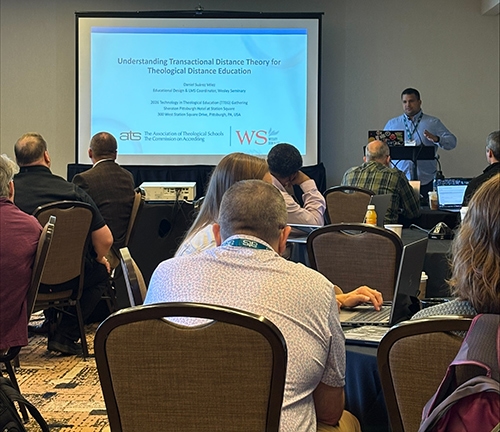
Understanding Transactional Distance Theory for Theological Distance Education, led by Daniel Suarez, educational design and LMS coordinator at Wesley
Seminary. Here, participants engaged in experiments using AI‑supported tools to strengthen interaction, clarify structure, and scaffold autonomy. They left with a greater
understanding of what impacts distance education and how design can be a tool to expand accessibility.
Another valuable aspect of the gathering was the opportunity for participants to connect around their particular areas of responsibility, whether EdTech or IT. While many professionals work
across both disciplines, these focused discussions allowed them to explore issues, challenges, and emerging needs more deeply with colleagues who shared similar roles. Participants then
brought questions and insights from those conversations back to the larger group, enriching the broader discussion.
Human involvement: a common denominator
One element stressed throughout the gathering was the importance of human coordination with any AI program.
Alkhoury asked participants to consider where AI can appropriately support the user’s goals, and where human presence, communal discernment, and contextual engagement must remain
central.
Rodríguez-Cortés reminded attendees that effective AI adoption requires intentional workflows grounded in sound educational practice.
In “Building a Cyber Security Assessment Your Seminary Can Actually Maintain,” session leader Jim Rispin of International Theological Seminary reminded participants that while
most security assessments are successfully written and answered by IT, they don’t measure what happens in the registrar’s office at 4:45 on a Friday afternoon. He also stressed
the critical nature of cyber security, highlighting risks that people seldom realize and offered participants a resource for cyber security assessment.
Opportunities and limitations
The event highlighted AI’s potential to make theological education more efficient and accessible, while creating opportunities for deeper learning. When used thoughtfully, AI can serve
as a learning companion, helping students explore ideas and expand their understanding. At the same time, its use raises important ethical questions, requires adequate resources, and demands
a clear understanding of its limitations.
“Ultimately, educators must be intentional about not only how they use AI, but why they use it—and ensure that it supports, rather than replaces, critical thinking and meaningful
learning,” said Yarborough. She also stressed that conversations about technology are critical for theological schools.
“Institutions need to ensure that their use of technology, especially AI, aligns with their mission and ethical commitments,” she said. “They must also consider not only the
initial cost of implementing new technologies, but also the ongoing expenses and how to provide students with the accessibility tools they need within limited budgets.”
Yarborough also emphasized the importance of ensuring that technology professionals have a seat at the decision-making table, working alongside institutional leaders to develop effective
strategies for integrating technology into theological education.
Attendee Hotze-Wilton agrees with Yarborough’s overall assessment of the event.
“I enjoy gathering with this particular group because there is a sense of being in this together,” she said. “Sharing lived experiences from our schools can happen around
the dinner table, in working groups, and in the workshop sessions. I highly recommend the annual ATS TTEG gathering to anyone considering going!"
“I left with new, concrete solutions to issues that had seemed difficult to resolve and have already started implementing those solutions,” added attendee Albert.
Founded in 2008, TTEG is open to those at ATS member schools who are engaged in information technology and online learning strategies.
Article Image 1: Daniel Suarez, educational design and LMS coordinator at Wesley Seminary, presents on "Understanding Transactional
Distance Theory for Theological Distance Education."
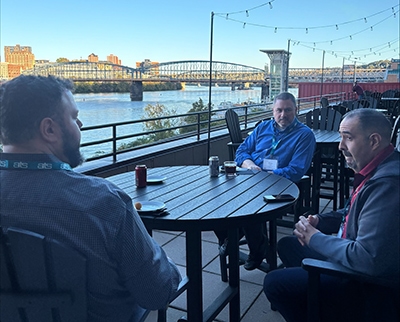
Article Image 2: TTEG participants converse outside the gathering venue in downtown Pittsburgh, PA.