 Formation for plural pathways: another story told by ATS alum/workforce data
By Christopher M. The
Access a downloadable
PDF version of this article.
A coherent career does not need to be singular. For some ATS member school alums, a working life spans multiple positions. In many cases, that pattern is already visible at graduation and
appears again years later. If theological formation has often imagined a graduate moving toward one primary position, these data invite schools to broaden the vocational imagination animating
that formational task.
Conventional wisdom suggests that graduates of ATS member school programs work multiple positions—but how common is
it? Nearly three in 10 (29 percent) employed alums reported holding more than one position when they completed the ATS Alum/Mapping the Workforce study in 2022–23. That
study included 3,556 alums across 129 ATS member schools represented in the data. As we look ahead to the next fielding in spring 2027, a retrospective of those results offers a useful
historical baseline for this cross-sectional survey.
'Ministry plus a day job' describes only part of the story
Not all multiple-position arrangements are the same—and this is true of the questionnaire, too. ATS asked employed respondents, "Do you currently hold multiple positions?" and offered
three different affirmative responses. Seeing those responses separately (Table 1) matters before interpreting what "multivocational" or "multipositional" work (Table 2) might mean.
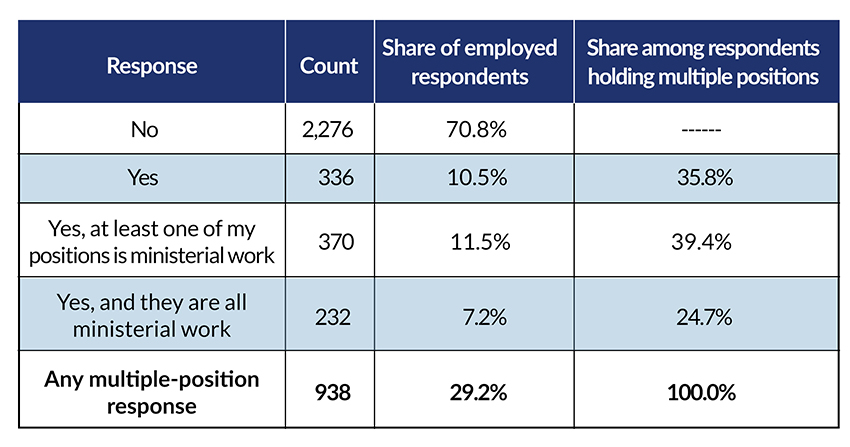
Table 1. How "multiple positions" looked on the questionnaire
Alum/Workforce 2022, item 16d: "Do you currently hold multiple positions?"
Source: Alum/Workforce 2022, item 16d; n=3,214 employed respondents with a usable, mutually exclusive response. The unqualified
response "Yes" does not mean nonministerial; ministry status was simply unspecified.
Among the 938 alums holding multiple positions, 39 percent said at least one position was ministerial, 25 percent said all positions were ministerial, and just under 36 percent simply
reported multiple positions without specifying whether any were ministerial (Alum/Workforce 2022, item 16d). Some alums combined forms of ministry. Others worked across education, health
care, nonprofits, business, and other settings. A single story of bivocational ministry cannot hold all of those working lives.
For schools with broad educational missions, that span raises a basic question: when your school's vocational advising imagines a graduate's future, how many possible pathways of work are
imagined? What forms of coherence become visible when more than one role is allowed into view?
This story's clearest pattern reaches back to graduation
The Alum/Workforce 2022 study also asked retrospectively, "Upon graduating from our school, did you hold multiple positions?" Respondents could answer "No," "Yes," or "Yes, and at least one
of my positions was ministerial work (bivocational ministry)." Linking that graduation-era report for the classes of 2010–11, 2014–15, and 2019–20 to employment
circumstances at the time of the survey produces a clear finding.
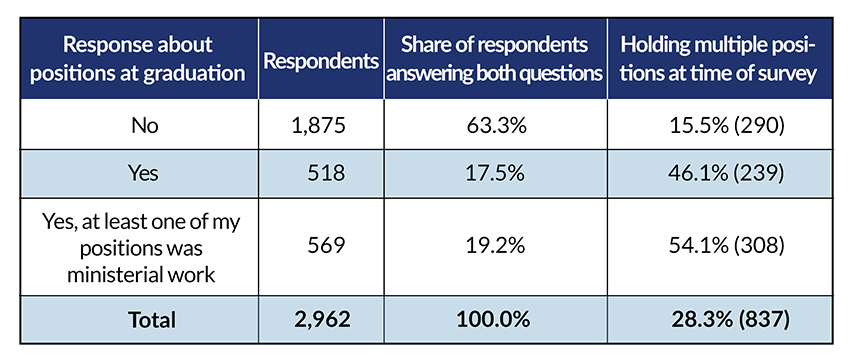
Table 2. Multiple-position work at graduation and at the time of survey
Alum/Workforce 2022, item 14a1: "Upon graduating from our school, did you hold multiple positions?"
Source: Alum/Workforce 2022, items 14a1 and 16d; n=2,962 with usable responses to both single-select items. The graduation categories are mutually
exclusive.
Among alums who reported one position at graduation, nearly 16 percent reported multiple positions at the time of the survey. Compare that share with 46 percent among those who had answered
an unqualified "Yes" at graduation and 54 percent among those whose graduation-era arrangement explicitly included ministerial work. This survey does not observe the intervening years, so the
comparison is not evidence of uninterrupted continuity. It does show that the shape of work reported around graduation is strongly associated with the shape reported years later.
That relationship survives several statistical checks, remaining strong after accounting for degree/program, graduating cohort, age, gender, marital status, race/ethnicity, international
status, respondent denomination, selected employment-history measures, and the clustering of respondents within schools. ATS Student Data Services also looked for broad institutional
explanations. Organizational affiliation or freestanding status, ATS-Carnegie classification, enrollment size, and country did little to distinguish current multiple-position work in these
analyses. Ecclesial family did show an association, with higher rates among Roman Catholic/Orthodox schools represented in the data. Much of that difference appears to reflect who those
schools' alums are: in particular, Catholic clergy who self-reported holding multiple positions—which may encompass multiple parish assignments or other priestly duties—rather
than something about a school's religious tradition. Either way, accounting for school ecclesial family
and Catholic vocational status, or excluding current Catholic clergy altogether left the link between graduation-era and later multiple-position work essentially unchanged.
The implication is not that every multiple-position arrangement is permanent, chosen, or even desirable. That said, if a student is already assembling a working life across positions at
graduation, the above data suggest that arrangement should not automatically be assumed to be temporary.
Early work settings offer another clue
When looking at the context of initial post-graduation professional work, teaching or educational setting stands out. Among 2,956 alums with usable, comparable data, 47 percent of
those whose first professional work included a teaching or educational setting reported multiple positions years later, compared with 24 percent of those whose first professional work did not
include teaching or education. The association remained after accounting for multiple-position status at graduation, degree, graduation cohort, and whether the first professional position was
full- or part-time.
The faith-based nonprofit response pattern offered a smaller but similar association: 41 percent of alums whose first professional work included that setting reported multiple
positions at the time of the survey, compared with 27 percent among those who did not identify that context. Association is not evidence that either education or nonprofit work causes a
plural career trajectory. Among the initial post-graduation work settings tested, however, these two showed the clearest positive associations after accounting for the other factors in the
analysis.
Credential expectations point toward overlapping pathways, overlapping workplaces
As mentioned in a recent Colloquy article, the same ATS study asked which credentials an
employer expected for the respondent's reported current role. Among 3,070 alums with at least one credential response, a "teaching license or credential" was reported for eight percent of
multiple-position alums, compared with five percent of single-position alums; "spiritual direction/life coach" credentials were reported for five percent, compared with two percent. The
survey's "ordained or ordination track" response moved modestly in the other direction: 45 percent among multiple-position alums, compared with 51 percent among single-position alums. These
differences remained distinguishable after correction for the set of credential comparisons.
Those figures do not mean every school needs to add more credentials. They describe employer expectations attached to one reported current role, not an inventory of every credential held or
expected across an alum's positions. The more useful prompt posed by this story is whether your students understand the professional ecosystems adjacent to theological
education—and how their learning and formation accompany them on their paths.
The figures describe a pattern, not a plan
The data ATS has collected do not tell us whether multiple-position work was chosen or financially necessary, satisfying or exhausting, temporary or sustainable. Nonetheless, the data can sharpen questions about institutional planning and formative evaluation while students are in their
programs.
-
Do vocational discernment efforts make room for combinations, not only destinations? Student advising can still ask where adult learners feel called to serve. It
might also ask which roles could belong together as a portfolio career, which settings could draw on similar formational processes and competencies, and what vocational through-line
might make several types of work feel genuinely coherent. Field education, internships, and capstone reflection may provide places to test that integration with openness rather than
treating a second role as noise around the "real" one.
-
Are students practicing durable skills and demonstrating transferable capacities? The recurring education/teaching finding does not establish a distinctive
competency set for multiple-job alums. Yet, it does invite schools to consider whether students have opportunities to practice capacities that can travel—for example, teaching
for transformation, leading and facilitating groups, communicating complex ideas across audiences, translating theological insights for different settings, and recognizing connections
across forms of service. The worthwhile question is less whether to add another specialty than whether theological education helps students recognize what they can carry from one
setting into another.
-
Do students understand adjacent vocational pathways? Certain credential expectations appear more often in the reported roles of multiple-position alums. Your school
need not become the provider of every license or certification. It can, however, help students understand which opportunities complement theological education, where external
partnerships may make sense for the school, and how different forms of vocational preparation can fit together across a working life and over the life course.
The story these data tell brings us to vocational imagination. Theological education has long helped students ask what kind of work is faithful to a call. The responses collected pose another
question: what if that faithful work is distributed across more than one role? Coherence may not reside in a certain job title, but in the capacities, commitments, and communities that
connect several forms of work and vocation.
Might these multipositional patterns be seen again? Will future alum data show changing or steadying trajectories? The next fielding of the ATS Alum/Mapping the Workforce Survey in spring
2027 is your school's chance to test whether these plural-pathway patterns are holding, shifting, or accelerating among your own graduates. Thanks to the generosity of Lilly Endowment Inc.,
participation costs nothing to your school and will yield rich data that no single ATS member school could gather on its own.
Chief academic officers may wish to identify their school's coordinator(s) for the 2027 Alum/Mapping the Workforce Survey and encourage them to register for a no-cost, online information session for coordinators that ATS will host on Tuesday, October 13, at
11:00 a.m. ET (60 minutes).
Where might your school broaden a vocational imagination within theological formation itself? What emerging story might your student data tell?
The ATS Student Questionnaires offer additional ways to explore student and alum pathways. Continue the conversation on
Engage ATS, or reach out to Qmail@ats.edu for more information.
Statistical supplement available upon request.

Christopher M. The is director of
student data and research at
The Association of Theological Schools
in Pittsburgh, Pennsylvania.